Prioritize your Wellness Budget

During these financially trying times, you may find that you are forced to review your monthly expenses. Certainly, the cost of living has increased in all areas, so some adjustments have likely been necessary. As a small business owner, my own costs have steadily increased in all areas over the past few years. So, the challenge becomes sustaining your wellness goals during fiscally turbulent times.

Employee health insurance benefits help to meet your personal wellness goals. Full or partial coverage for services such as massage therapy, physiotherapy, counselling and psychotherapy ensures that your wellness goals are supported in holistic ways. Progressive employers understand the profound merit of supporting employee health and wellness through comprehensive benefit plans. This support can continue after retirement for those people who opt to continue to purchase them. Your family doctor is also likely to support your needs for referral to services that help to address physical, emotional, and mental ailments.

So, explore what your employer has co-purchased with you, and make sure that you are utilizing your benefit coverage. Finding a therapist to meet with on a bi-weekly basis will help you to gain clarity on your emotional, mental, and spiritual wellness goals that can, in turn, help you to mobilize into action. Two sessions per month can really make a difference in your overall mental, physical, and environmental health and wellness. Improving your mood, confidence levels, and self-esteem are generally fundamental to feeling well. Research also shows that moderate regular exercise including walking has positive impacts on overall health and wellness.

You may find adding “wellness” to your monthly budget a helpful exercise. Costs associated with your gym membership, paramedical health services, and monthly beauty-care can be organized under wellness. Some of you may wish to include your costs of food under this section as well. For many, the quality of food is not compromised by increases in costs even though there may be a significant change in the budget allotted for food. Where your food costs have increased significantly, what remains in your wellness budget may be strained also.

So, you may decide to forgo your regular monthly facial or similar beauty service to ensure that your food quality remains intact. Another strategy may be to prolong time between services, so that you can afford everything in your budget. In this example, your facial or beauty service happens every other month rather than monthly. In a similar way, you can also stretch your health insurance coverage by engaging in monthly counselling or massage services rather than bi-weekly sessions. Talk to your therapist about ways to sustain your counselling sessions without negative financial impact. Many therapists offer subsidies and will adjust your fee or schedule of interventions accordingly.

Readjusting your budget when costs are rising is always challenging for everybody. It calls for you to clarify what items in your budget are priorities and the reasons that you prioritize them. Including your “wellness” goals in your monthly budgeting will help to ensure that you remain healthy during financially trying times. Remember that your health and wellness is important and that you deserve to be well!

Lisa Romano-Dwyer BSc, MSW, PhD, RSW

In Harmony with Self & Nature

Nature & Inner Harmony

The restorative aspects of nature has long been verified in both folk lore and science. The further you drive away from the city, the fresher the air may feel. Enjoying long walks, hikes, trails, or climbs in nature affords you the opportunity to learn from the environment. Retreating to the countryside, conservation areas, local parks or beaches gives your body, mind, and spirit the chance to reconnect with nature in the wild and to reflect on your own corporeal nature.

There is no doubt that modern modes of work have increased demands on cerebral functioning. Business and service industries have migrated to online platforms. Even those jobs that require direct or in-person contact have increased digitization and techo-merging with computer systems and processes aimed to streamline administrative and staffing functions such as scheduling, attendance, payroll, and more. The amount of time required to merge traditional labour, as you know it to virtual webspaces has been enormous. It remains to be seen what the toll of this work will be on the human brain and body.

Cognitive Fatigue & Burnout

More and more clients disclose symptoms consistent with adrenal and cognitive fatigue that typically result from extended periods of extreme stress. There appear to be a set of shared mental and physical impacts created by working too much, too hard, and for too long. Clients who avoid symptoms of overwork are at greater risk of burnout. Learning to identify when to take a break is a critical first step in sustaining your wellness over the long term. Once you begin to become aware of your need to take a break, the next challenge will find ways to integrate these into your work and play days.

Your body is usually the best measure of your health and wellness. Your corporeal self is essentially made up of the same materials found in all other life forms on the planet. When you find time to rest and recharge in nature, you benefit from the subtle nuances of natural rhythms you encounter when walking through a field, forest, or mountain top. You are exposed to reproductive, life and death cycles, and seasonal changes in all the plant and animal life that surrounds you. Being close witnesses to these miracles of nature will likely lead you to a deeper reflective view of yourself in nature as well.

In my clinical practice, understanding the self is a lifelong process of deep introspection and reflection. It is an integrative journey of self-knowledge that includes your body, mind, and spirit. A lack of balance in your life generally leads to problems in one of these three areas of the physical, mental, or spiritual self. Journeys of recovery and healing require you to regain balance in one or all areas. Years of self-neglect may require months or years of recovery. Getting to know yourself is a cool journey. Getting to a state of inner harmony where you appreciate that your life is as miraculous as those miracles of nature you see regularly on a casual walk each day is well worth the time you invest in yourself.

There are several natural cycles that you experience each day as well. These bio-rhythms include sleep, digestion, menstrual cycles, and hormonal changes. Some bio-rhythms change hourly, others daily, and even others progressively change over several years as you age. As a younger woman, I had regular menstrual periods that were consistent and not terribly painful. As a married woman, my sexual activity was connected to a loving partner who agreed to a family planning method that did not rely on the pill. I noticed many things about my monthly cycle that did in fact change when stressed, overworked, or with changes in the number of daylight hours. I had a relatively longer cycle that was usually 32 days in length, while many peers had shorter cycles. When work had been particularly stressful, I noticed a delay in my period by up to two weeks. Many women shared similar experiences and reflected on the impact of stress on this regular monthly hormone driven bio-rhythm.

Peri-menopause and menopause itself is another very intense period of several years where natural bio-cycles progressively change and on many levels. My professional and personal approach to care has always been bio-psycho-social. Understanding the self must include a corporeal perspective that allows you to be aware of the changes in your body when distressed. You may learn that you lose your appetite for food, sleep, or sex under great stress, or alternatively that your desires for food, sleep, substances, or sex grow as a means to release a build-up of toxic energy or the primary stress hormone cortisol. Some people make reckless decisions when distressed and regret that they failed to learn healthier coping strategies sooner. Practices such as yoga, Taiichi, mindful meditation, or contemplative prayer offer opportunities for you to slow down and “feel” your body‘s cardio and breathing rates. Newer technologies such as the Apple Watch, or Fitbit also provide you with immediate bio-feedback that can help you to identify signs of overwork as well as periods of rest.

Achieving states of inner harmony at different developmental stages in your life is possible when you care for yourself as a miraculous creation of nature. Self-love flows when you accept the fragility of your human body, and nurture yourself for health and wellness over the long term.

Lisa Romano-Dwyer BSc, MSW, PhD, RSW

In Memory of My Big Brother Mike

R.I.P. April 5, 2015

My older brother Mike died 5 years ago today. He lived a very full life and enjoyed much of his 57 years on earth. He was the second of six children born in rapid succession to my mother and father after immigrating to Canada following world war two. Had Mike not succumbed to his declining health related to Hep C and prolonged methadone use, he would have been 62 years old this December.

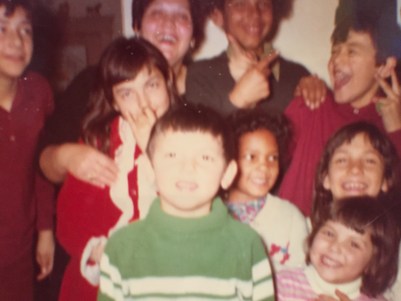
Family 1970’s Toronto – Mike is holding up his Peace Sign. I’m all smiles in pink on the bottom right.

Mike was an active and smart student excelling in his elementary school years. He attended a local high school where he dropped out of school in grade 10. Mike later disclosed that he began to skip school when his gym teacher mandated swimming in the nude. He opted to hang out at the local park instead. Like any good mother, our mom supported Mike skipping gym as he felt self-conscious in the nude. What she did not see coming was Mike meeting up with other teenagers who had less interest in schooling.

In an all too common story, it was during these formative years that Mike began to experiment with alcohol and drugs. In the ’70’s, it was common for young people to be hired for full-time employment and Mike landed himself a job as a grocer at a local store owned by Weston Foods called Loblaw. He stayed working as a grocer until moving to work as a Landscaper with the City of Toronto in 1982. Mike worked with the City, and then Metro for 28 years.

Mike’s teenage experimentation with drugs and alcohol did, in fact, become the gateway to a lifelong addiction to alcohol, gambling, and street drugs. Our mother stood beside Mike, and tried to support his personal battles with addiction and gambling. Mike was always a happy drunk who never quite learned to identify when he had enough. Mike was an addict who could not keep money in his pocket. Like many people who suffer with addictions, Mike’s drinking was his emotional burden he carried for most of his adult life.

His addiction to street drugs was mediated with an extensive treatment program provided by a team of specialists at CAMH and his inclusion in the methadone harm reduction program. This methadone program saved Mike‘s life. Similar to the effect of alcohol, Mike was happiest when he was high. It was only when the alcohol and drugs tapered off that his overwhelming sense of sadness and depression would rise up.

Mike was deeply remorseful about the negative impacts of his addictions on our Mother, family, love-interests, colleagues, and his own health. In his lowest points, he felt such intense shame about his personal vices. Mike did engage in counselling treatment and did his best to change his unhealthy ways. He failed more times than not, but never gave up. Mike stayed close to family and we hung in there for him.

As the youngest in the family, Mike was always my Big Brother. In my eyes, he was strong, fearless, and protective. I learned to be confident and brave in part, because I always knew that Mike would be there to protect me. He relied on me quite a bit. He knew that I would never give him money or alcohol. But I always had an ear and meal whenever he felt lonely and sad. Mike would drop in often, and did take interest in all our children. He was like our family guard dog always watchful that our children were safe and well.

As his health declined, Mike told me that he would rather die than lose his legs. One of his greatest fears was to be an amputee, like many of his chronic alcoholic friends who lived in a local rehab hospital.

When Mike died, all of us were with him. He died peacefully surrounded by all of his siblings and their partners at our local hospital. In truth, everyone loved Mike. He always had a funny thing to say and he would say it when it was least expected – making everyone laugh. Mike was a sincere and loyal friend. He enjoyed comedy and music. He protected the weak and stood up for people he believed were mistreated.

The family was prepared to meet up at the cemetery today to reminisce about Mike’s life, but was prevented by COVID 19 physical distancing restrictions. Mike will forever be in our hearts. He has shaped my work in harm reduction and addictions care. He taught me about co-dependence, healthy limit-setting, and the importance of humanity in care providing roles with all people.

Sunny dispositions deserve to shine!!!!

#wellness #healthy #family #addiction #concurrent disorders #codependence #harmreduction